
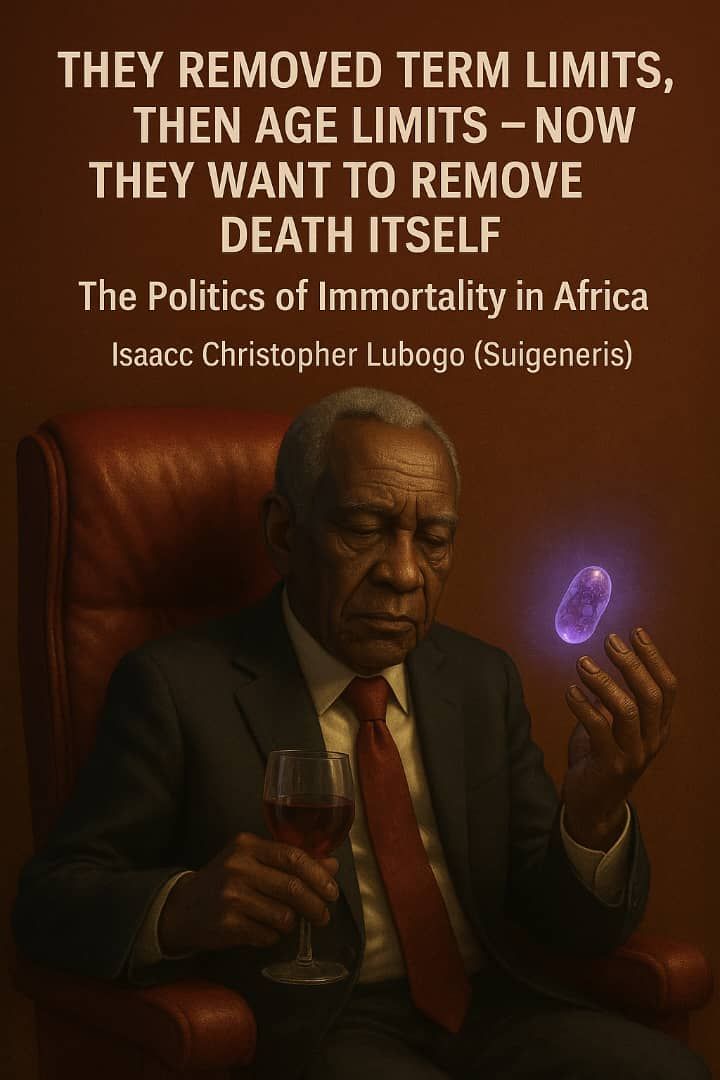
“Even Methuselah died — immortality without meaning is merely prolonged decay.”
They Removed Term Limits, Then Age Limits — Now They Want to Remove Death Itself: The Politics of Immortality in Africa
By. Isaac Christopher Lubogo (Suigeneris)
Legal Scholar and Philosopher
Abstract
This discourse explores the intersection of biomedical science and political philosophy through the lens of Procyanidin C1 (PCC1)—a natural senolytic compound with potential anti-aging properties. It examines how the pursuit of longevity, when filtered through Africa’s political landscape, tempts leaders to equate biological renewal with political perpetuity. Blending humor, science, and theology, the essay warns of an emerging ideology of immortality among rulers who have already dismantled constitutional limits and now flirt with the abolition of mortality itself.
Keywords
Longevity · Procyanidin C1 · Senolytics · Political Power · Immortality · Africa · Leadership · Philosophy
Prologue: When Presidents Start Negotiating with Death
Once, they only dreamed of leading a generation.
Now, they dream of leading eternity.
First, they removed term limits—a rehearsal for infinity.
Then they abolished age limits—a declaration that chronology itself is negotiable.
And just when mortality seemed the only constitution that could not be amended, a whisper from a laboratory announced a new discovery: Procyanidin C1 (PCC1)—a grape-seed molecule that kills old cells and renews the young.
So pause—yes, wait a minute.
Could it be that after moving all the goalposts of law, time, and reason, they have finally found the last one—death itself?
Perhaps, after decades of rewriting rules, reshaping constitutions, and reshuffling reality, they have stumbled upon the ultimate amendment: the Abolition of Dying Act.
Welcome to the age when presidents start negotiating with death.
This discourse is at once humor and alarm, prophecy and pathology—a philosophical alert that says: they may finally have got it after all.
I. The Grape That Could Outrun God
Procyanidin C1, the molecule in question, is a proanthocyanidin trimer found in grape seeds and cocoa.
In scientific terms, it is a senolytic—a compound that targets senescent cells, those retired and unproductive residents that refuse to die yet poison their surroundings with toxic inflammatory signals known as the SASP (Senescence-Associated Secretory Phenotype).
At low doses, PCC1 tells these cells to quiet down.
At high doses, it politely escorts them to programmed death—cellular apoptosis.
In mice, PCC1 restored muscle strength, endurance, and even extended lifespan.
In political imagination, however, it restored something far more dangerous—ambition.
For a tired politician, PCC1 is not a molecule. It is mandate renewal in a capsule.
In the wrong bloodstream, medicine becomes manifesto.
II. The Biology of Overstay
Biologically speaking, senescent cells are a perfect metaphor for African leadership.
They have stopped dividing yet occupy space.
They serve no function yet secrete toxins of arrogance and decay.
They are immune to feedback and allergic to exit.
PCC1’s purpose is to clear them out—to make room for new, functional cells.
If only such a compound could be injected into our political systems.
Imagine a national policy of political senolytics:
two doses every election, administered through ballots, not bullets.
Side-effects: accountability and renewal.
But our leaders prefer a different dosage—one that keeps them young while the nation grows old.
Soon, the slogans will read:
“Vote for Experience—Now Rejuvenated!”
“Biology Has Spoken: Continuity Is Stability!”
III. The Presidential Paradox—Old Men, New Molecules
Africa, that magnificent continent of youth, is ruled by the most aged of men.
Some have governed longer than the life expectancy of their citizens.
Their birthdays are state secrets; their reigns measured not in years but in geological layers.
Now picture these patriarchs discovering PCC1.
They would not see longevity science—they would see a leadership supplement.
And they would not call it anti-aging—they would call it the second liberation.
If term limits can be removed by parliament, why can’t death limits be repealed by science?
If the people cannot retire me, why should time?
IV. The Philosophy of Forever
Aristotle taught that virtue lies in moderation.
But in the African palace, excess has become the new excellence.
Our leaders equate duration with destiny, mistaking long life for legacy and stamina for service.
Kant would say that to desire immortality without moral growth is to extend one’s punishment.
Nietzsche would sneer: the will to power has become the will to persist.
And Scripture warns:
“It is appointed unto man once to die.” — Hebrews 9:27
Yet our rulers have appointed themselves otherwise.
They seek to make time their civil servant and eternity their bodyguard.
V. The Theology of Hubris
In Eden, man was told, “You shall not surely die”—the first false promise of immortality.
Today that whisper returns wearing a lab coat.
The scientist says, we can reverse aging.
The president hears, you can reign forever.
They do not want to live; they fear to leave.
They have already baptized themselves in constitutional immortality and now seek cellular resurrection.
Soon they will rewrite funerals as policy errors.
Coffins will be contraband.
Succession will be sacrilege.
Thus the ancient sin of Adam evolves into a modern protocol:
Project Eternal Command.
VI. The Moral Cost of Forever
Longevity is a gift; eternity a trap.
For in a world where leaders do not die, citizens do not live.
Without mortality, there can be no morality.
What happens to democracy when a ruler’s lifespan becomes infinite?
Succession collapses. Innovation withers.
Youth become spectators in the museum of power.
The tragedy is not that our presidents grow old—it is that their ideas do.
Give them PCC1 and they will glow with youthful skin while governing with prehistoric thought.
They will look forty-five but think nineteen-forty-five.
VII. The Real Prescription
If PCC1 must come to Africa, let it serve the sick, not the sovereign.
Let it heal the farmer’s back, not the general’s ego.
Let it rejuvenate teachers, not tyrants.
For Africa’s true senescence lies not in her cells but in her systems.
The cure is not molecular but moral.
What our continent needs is institutional regeneration, not cellular rejuvenation.
VIII. The Final Negotiation
Even if science could bribe death for a while, Time would still send the invoice.
Time is the only dictator that cannot be overthrown,
and death the only democrat that counts every citizen equally.
The rejuvenated ruler may delay his funeral, but he cannot resurrect his relevance.
And when the nation he preserved for himself finally outlives him, history will write on his monument:
He conquered dying but failed to live.
IX. The Deathless Republic
Behold the coming paradox:
A continent of youth governed by immortal elders.
A democracy without departure.
A calendar without change.
If PCC1 becomes policy, the Republic itself will turn senescent—living yet decaying, breathing yet motionless.
It will be the Deathless Republic, where no one dies but nothing truly lives.
X. The Closing Irony—The Wine of Forever
It is poetic justice that PCC1 comes from grapes—the same fruit that yields wine, symbol of both revelation and ruin.
Wine that can bless or intoxicate.
So too with this molecule: salvation or seduction.
Let our leaders drink wisely, lest they become drunk on eternity.
For immortality without humility is heresy.
Even Methuselah died.
Even Pharaoh drowned.
Even the grape was crushed to release its power.
So let them live long if they must—but let them live well.
For when man tries to abolish death, he merely prolongs his funeral.
Epilogue: The Final Warning
Perhaps, after all the amendments of time and law, they have finally found it—the formula to outwit death.
Perhaps they will soon claim to have negotiated a new covenant with biology.
But before they celebrate immortality, let philosophy whisper from the grave:
“No man truly lives forever; only his deeds do.”
Let this research, therefore, not serve the hunger for power but the healing of humanity.
For the purpose of science is to extend life, not to embalm leadership.
References (Harvard Style)
Zhu Y et al. (2021) Procyanidin C1 is a natural senotherapeutic agent. Nature Metabolism 3(12): 1706–1720.
FightAging.org (2021) Procyanidin C1 as a Senotherapeutic. Available at: https://www.fightaging.org/archives/2021/12/procyanidin-c1-as-a-senotherapeutic/
Nature Editorial Note (2022) Data integrity review on Procyanidin C1 paper. Nature Metabolism.
Wikipedia (2024) Procyanidin C1. Available at: https://en.wikipedia.org/wiki/Procyanidin_C1
Footnotes
1 For instance, Uganda’s 2017 constitutional amendment scrapped the presidential age limit of 75 years, enabling continued incumbency.
2 Paul Biya of Cameroon, born 1933, has ruled since 1982; Teodoro Obiang Nguema Mbasogo of Equatorial Guinea since 1979—real-world case studies of “constitutional immortality.”
3 See Zhu et al. (2021) for laboratory evidence that Procyanidin C1 extends lifespan in mice; no human data yet exist.
The Politics of Immortality in Africa — End of Manuscript
 Bantu MEDIA